
Login
Sign in
Forgot password?
Enter your information

Please hold your phone upright
Bar Bambi opened in West Town with a name that sounded soft and a room that did not behave quietly. The Chicago Avenue bar, from bartender-owner Katie Renshaw, leaned into neon, glass brick, lounge seating, and a sinuous light piece over the bar that Chicago Magazine said Renshaw had nicknamed the "sexy spaghetti."
That detail mattered because the drinks were not shy either. Bar Bambi's menu took familiar forms — martini, Negroni, margarita, old fashioned — and pushed them through clarification, force carbonation, fat washing, and flavored infusions without making the guest read like a lab assistant. In a city that had never lacked serious cocktail technique, Renshaw seemed less interested in proving the work than in hiding the screws.
Bar Bambi sits at 1703 W. Chicago Ave., on a West Town stretch already thick with dinner traffic and second-stop drinking. Chicago Magazine reported that it opened in February 2026, while earlier coverage from Eater Chicago had framed the project as a classic-drinks bar filtered through molecular methods. Time Out Chicago later described the space as designed by Gensler, with Renshaw's style coming through in the room as much as in the glass.
The room seats about 50, according to pre-opening coverage, which put it in a useful size category: small enough for the bartender's intent to survive service, large enough not to feel like a private joke. The visual language was not the usual brown-on-brown temple of stirred drinks. Pink tones, glass brick, soft seating, and the overhead light sculpture gave the bar a theatrical edge — but theater, at its best, still needs blocking.
I tend to distrust bars that explain their whimsy before the first drink lands. Bar Bambi's better move was that the silliness appeared to be load-bearing: it gave advanced technique permission to loosen its tie.
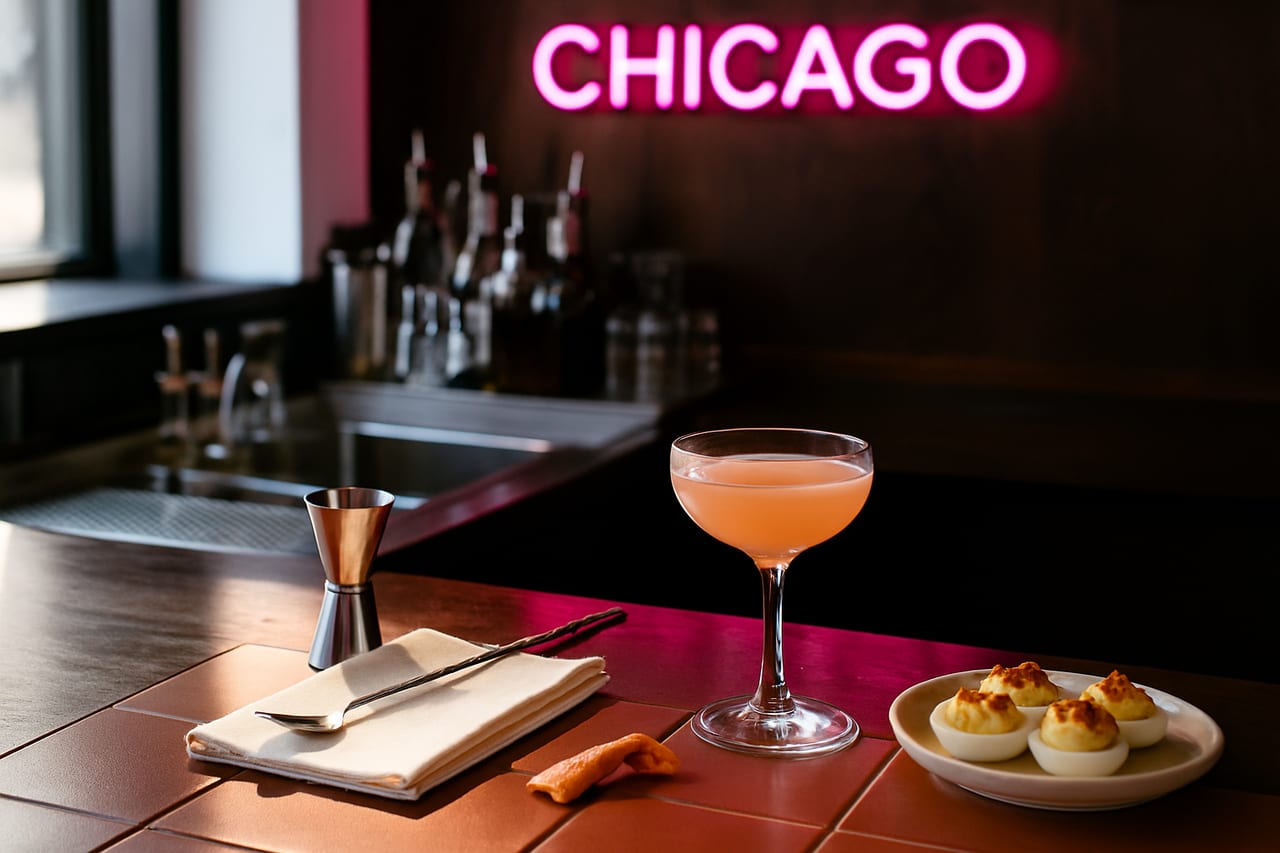
Renshaw had the resume to make a denser bar if she had wanted one. Chicago Magazine and other local outlets traced her time through Moneygun, GreenRiver, The Aviary, Billy Sunday, and Hawksmoor; Time Out Chicago also identified her as the 2019 U.S. Bartender of the Year. Those credentials could have turned Bar Bambi into a credential show. Instead, the early reporting kept coming back to a simpler idea: modernist technique in a room that did not punish casual drinking.
The clearest example was the Three Decibel Rule, described by Chicago Magazine as Renshaw's lychee martini variation. Its build included clarified lychee and bell pepper, crème-fraîche-washed vodka, and an aromatized wine component. That was a lot of prep for a drink whose job, from the guest side, was still to read as a martini family member — cold, clean, aromatic, not a dissertation.
Another drink, the Skinny Dip, was described as a cream soda take with fig leaf-infused rum and Thai banana, force carbonated for texture. WTTW also singled out carbonation as one of the bar's signatures. Carbonation is unforgiving behind a bar: it turns weak prep into noise, and it turns good prep into pace. When used well, it gives the drink length without making it watery, which is one of the few modern tricks that can actually improve a classic template rather than decorate it.
The menu reportedly helped guests by pairing more technical builds with recognizable cocktail references. That was the right kind of translation. A short menu signals confidence; a menu that tells people where they are standing signals hospitality.
The point was not that Bar Bambi invented a new grammar. It used old grammar with a brighter alphabet. Eater Chicago previewed drinks such as a sparkling highball version of a martini and an old fashioned turned into a clarified whiskey sour, while Chicago Magazine later noted a raspberry Negroni touched with white chocolate and wasabi, plus a mezcal margarita inspired by mango sticky rice.
Those combinations could have gone badly. White chocolate and wasabi, in particular, is the kind of pairing that looks clever on paper and punishing in a coupe if the dilution is wrong. But Renshaw's stated approach, as reported by Chicago Magazine, was that the molecular work happened on the back end. That distinction is not cosmetic. The guest should feel the texture, not see the machinery.
It also put Bar Bambi in conversation with Chicago's own cocktail history. The city had long been associated with technical bars, sometimes brilliantly, sometimes with the emotional temperature of a tasting-menu invoice. Renshaw's bet was that the same tools could serve a looser room. The bar was not rejecting precision. It was rejecting stiffness.
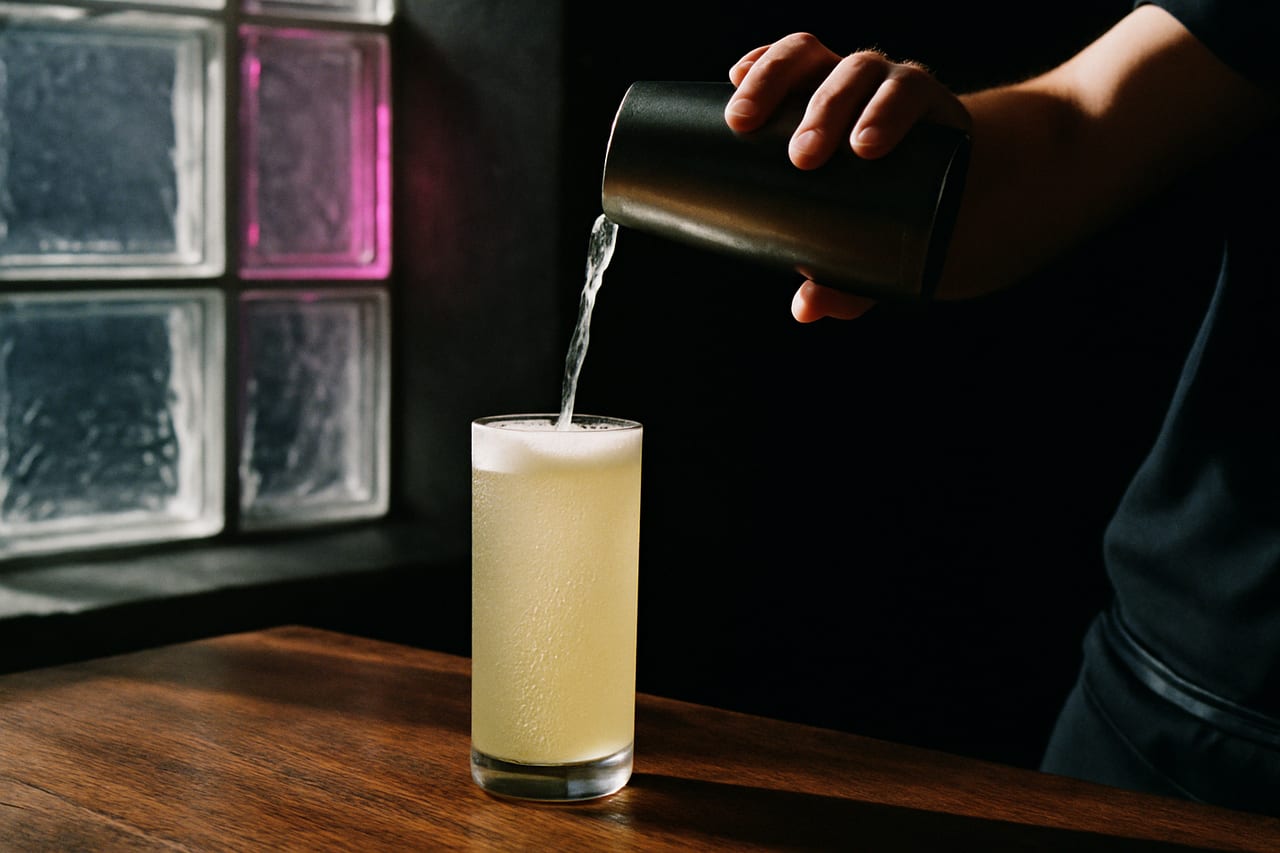
Bar snacks can expose a cocktail bar's priorities. Too little food and the room turns brittle by the second round; too much and the drinks become supporting actors. At Bar Bambi, chef Nicklus Byrns handled a compact menu that early coverage tied to his time at Elske and Pineapple & Pearls. Chicago Magazine pointed to deviled eggs with confit garlic and Calabrian chiles, beef tartare with pickled shiitakes, and a tempura halibut sandwich with triple pickle sauce, white American cheese, and iceberg lettuce.
That last dish mattered because it understood the room. A high-low fish sandwich does more for a bar like this than a careful little scallop ever could. It lets the neon breathe. It keeps people at the table without asking them to shift into dinner posture.
The Infatuation, in an April review, described the room as feeling like a loft party, with couches filling quickly after opening. That detail tracked with the rest of the reporting: Bar Bambi did not seem built for reverence. It seemed built for people who wanted one properly engineered drink, then another, while the room kept changing color around them.
Not every new bar needs a manifesto, but every good bar needs a position. Bar Bambi's position was legible: classics were useful not because they were sacred, but because guests already understood their silhouettes. Once the silhouette was clear, Renshaw could bend the drink toward lychee, fig leaf, Thai banana, mango sticky rice, or clarified whiskey without losing the guest.
That is harder than it sounds. A great cocktail is usually fewer than six ingredients, and even when the prep list gets longer, the finished drink still has to drink short. Garnish has to earn its place. Sweetness has to know when to leave. Most of all, the room has to make the drink feel inevitable.
Bar Bambi's early crowds suggested that West Town understood the offer. Chicago Magazine reported lines down the block on its first night; by May, the same publication had returned to write about the bar's draw as a place where modernist technique met a more relaxed environment. The useful word there was not modernist. It was relaxed.
Renshaw told Chicago Magazine, in one version of the bar's governing idea, that the team took the work seriously without taking themselves seriously. In a cocktail city with a long memory and a strong tolerance for intensity, that may be the more difficult build.





 Contacts
 Select language
To take part in the dialogue, you need to Log in.
To take part in the dialogue, you need to Log in.