
Login
Sign in
Forgot password?
Enter your information

Please hold your phone upright
The Saturday bottleneck usually showed itself before the first real complaint. A bartender reached for citrus, another waited for the soda gun, a ticket curled out of the printer, and the drink that should have taken 45 seconds drifted past two minutes. At that point the problem was not cocktail creativity. It was line design, prep discipline, and the quiet question every high-volume bar eventually had to answer: which parts of the drink actually needed to happen in front of the guest?
Draft cocktails were useful only when they were treated as an operations system, not as a novelty tap. The strongest examples did three things at once: they moved labor out of peak service, reduced variation between bartenders, and gave the room a clear ordering path when tables wanted one more round. The romance of watching every drink built to order did not pay the Saturday labor line by itself.
At Uno Mas in Edinburgh, co-owner Sian Buchan framed draught cocktails as a service and margin tool in a 2021 piece for CLASS. The bar was planned as a late-night, high-volume room, and Buchan wrote that consistency mattered whether a guest ordered at 5 p.m. or 2:30 a.m. That meant the real work had to happen before doors opened: batching, carbonation trials, keg management, and a garnish spec that did not turn a fast drink back into a slow one.
Buchan and bar manager Kat Stanley-Whyte started with four easygoing highballs, first testing recipes on a small carbonation setup before moving them onto the draught system. They learned that carbonation changed flavor perception. Sweetness needed adjusting; Campari pushed forward; some flavors took several days in keg before they landed correctly. The operational lesson was blunt: a tap did not remove R&D, it moved it earlier in the week.
Uno Mas also changed how the drinks were sold. Buchan said the draught cocktails were placed in their own menu section and priced slightly lower than other cocktails because the team could serve them quickly. Garnishes were restrained unless they added aroma or structure, as with a toasted rosemary sprig on a whisky-and-coconut serve. Most important, the kegs took hours to carbonate in the cellar, so par levels became a service-critical number, not a back-of-house footnote.
The result Buchan pointed to was not a theatrical one. In a two-hour table-service window, the ability to get each table one additional round could materially change the night’s bottom line. That is the right way to measure draft: not by whether it looks clever, but by whether it increases completed rounds without eroding the drink.
Munich’s Bar Charlatan took a more selective route. In a 2025 Mixology feature on pre-batching, Paulina Nowakowska described batching drinks only as far as shelf life allowed. The bar guaranteed at least six weeks of refrigerated stability for its prepared components, but added more perishable ingredients, such as fresh juices, à la minute. That boundary was the whole system.
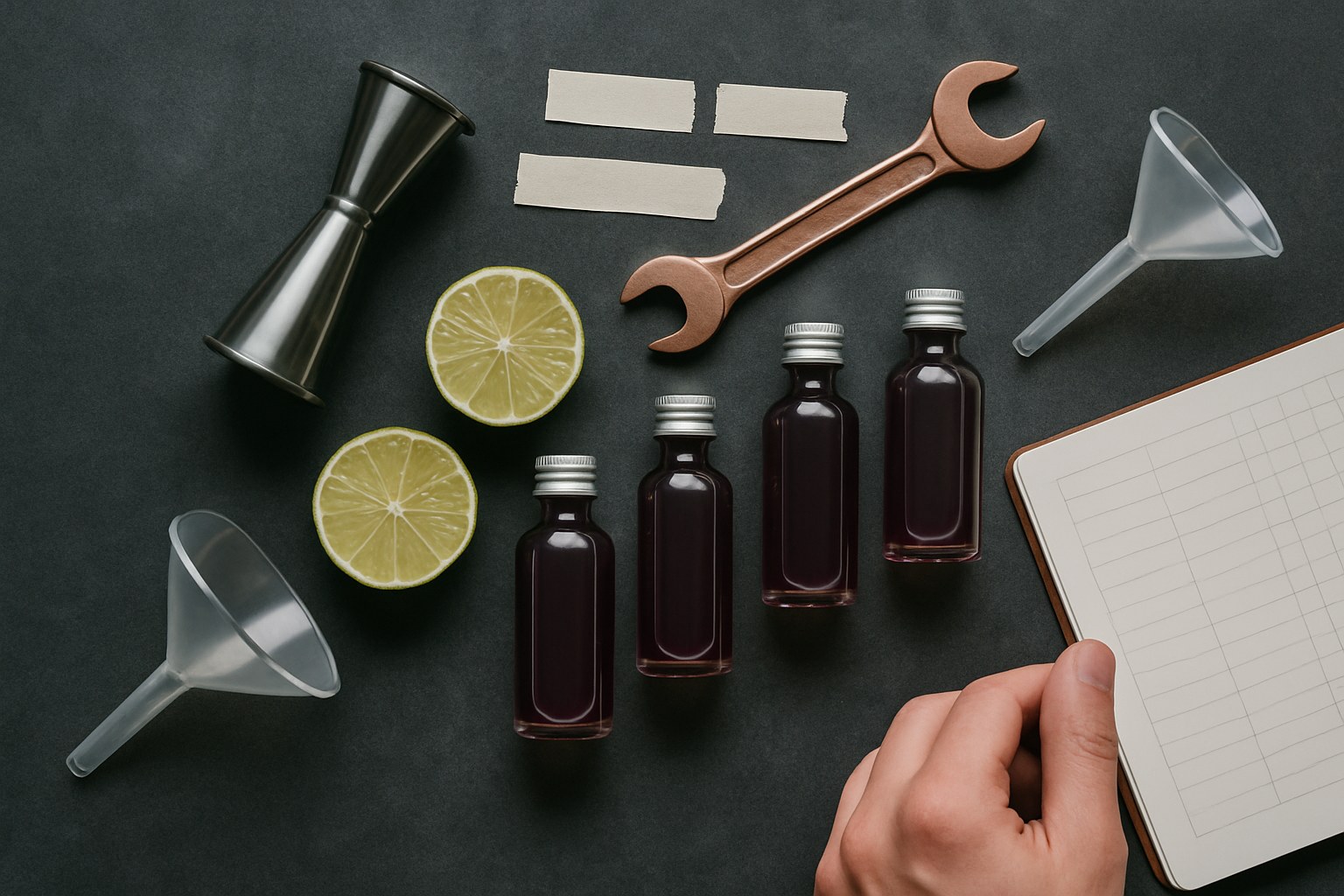
Her toolkit was not glamorous: filters, sieves, funnels, measuring cups, large canisters, precise notes, and clean labels. The useful action for managers was the minimum-hold standard. If a component could not meet the bar’s shelf-life rule, it did not belong in the batch. If it could, it was moved out of peak service and into measured prep.
The numbers mattered because they made the rule trainable. Nowakowska gave Mixology a preservation framework: target pH below 4.0, ideally below 3.5; higher alcohol for longer stability; and syrup around 55 to 60 Brix when sugar was doing preservation work. A busy bar does not need every bartender improvising food safety on Saturday night. It needs a standard that a new hire can read, execute, and check.
In Berlin, Velvet’s Sarah Fischer and Ruben Neideck described another useful constraint in the same Mixology report: small batches, usually around 40 cocktails. Their weekly changing menu made overproduction expensive, so the batch size followed the rhythm of the card. They used 5-liter measuring vessels, 1-liter scaled containers, pipettes, a 0.01-gram precision scale, calculators, steel funnels, and 500-ml glass bottles marked with washable labels.
That may sound fussy until the Saturday printer starts talking. Fischer and Neideck said batching let recipes with 10 to 15 ingredients become executable with one service movement, without forcing the bartender to measure tiny amounts during a rush. They also named the tradeoff: when batching becomes the primary method, junior staff may learn fewer classic building skills at the station. For an owner, that is not a reason to reject batching. It is a reason to separate production training from service training.
Velvet’s model was especially useful for bars with frequent menu changes. The team could develop on Tuesday, print and program on Wednesday, and batch without committing to industrial volumes. The operational point was not maximum scale. It was a batch size small enough to protect freshness and large enough to remove the slowest movements from service.

London’s Tayer + Elementary solved the bottleneck at the concept level. Difford’s Guide described Elementary, the front bar, as an all-day space serving simple, largely pre-batched drinks, including cocktails on tap, while Tayer in back handled the more progressive work. Alex Kratena and Monica Berg did not ask one station to be all things to all guests. They gave speed and complexity different rooms.
That split is an underrated staffing lesson. A front bar built around fast, consistent pours can absorb walk-ins, coffee, snacks, and first rounds without jamming the more technical counter behind it. The team still had to rotate roles and keep accountability clear, as Difford’s noted, but the guest pathway did some of the labor management before a bartender picked up a tin.
White Lyan, Ryan Chetiyawardana and Iain Griffiths’s now-closed London bar, pushed the logic further. In 2014, DRiNK reported that the bar used pre-batched, bottled, refrigerated cocktails with no citrus, no ice, no shaking, and no stirring. Chetiyawardana described the basis as control: removing variables so drinks could be served quickly and consistently. Most bars should not copy that model wholesale. They should copy the question underneath it: which variables create value for this room, and which ones only create drag?
The good draft cocktail did not make the bartender irrelevant. It made the bartender available again: to watch the room, catch a table before it went dry, and keep the station from turning into a museum of half-finished movements.





 Contacts
 Select language
To take part in the dialogue, you need to Log in.
To take part in the dialogue, you need to Log in.